May 28, 2026 Allen Levin
People are no longer finding businesses the same way they used to.
A few years ago, a potential client would search on Google, click through a few websites, read reviews, and decide who to call. That still happens, but now more people are asking AI tools for answers.
They may ask:
“Who is the best personal injury lawyer near me?”
“What attorney can help me after a car accident?”
“Which law firm offers free consultations?”
If your firm does not show up in those AI-driven answers, you may never get the chance to speak with that client.
That is why AI visibility matters.
AI visibility means your firm is easy for AI tools to understand, mention, and recommend. If AI cannot clearly understand what your firm does, who you help, and where you operate, it may recommend another firm instead.
Here is how to start fixing that.
The first step is simple. Search the way a real client would.
Ask AI tools questions like:
“Best car accident lawyer near me”
“Who can help me after a workplace injury?”
“What law firm handles personal injury cases in my city?”
Then look at the answers.
Does your firm appear? Do your competitors appear? Is the information accurate? Does AI understand your practice areas correctly?
This gives you a clear starting point. Before you improve your AI visibility, you need to know where your firm currently stands.
AI cannot recommend your firm if your website is too vague.
Many law firm websites use phrases like “experienced attorneys,” “trusted legal support,” or “client-focused representation.” Those sound professional, but they do not always explain what the firm actually does.
Your website should clearly say what types of cases you handle.
If you help with personal injury, car accidents, immigration, family law, criminal defense, or business law, each service should be explained clearly. A potential client should not have to guess whether you can help them.
For example, instead of only saying “we handle personal injury cases,” explain what that means. Talk about car accidents, medical bills, insurance claims, consultations, and what someone should do next.
The clearer your content is, the easier it is for both people and AI to understand your firm.
Most clients do not start by knowing exactly what legal service they need.
They usually start with a problem.
They ask things like:
“What should I do after a car accident?”
“Do I need a lawyer if the insurance company already called me?”
“How long do I have to file a claim?”
“What happens during a legal consultation?”
Your website should answer these questions in simple language.
This is important for two reasons. First, it helps potential clients feel more confident. Second, it gives AI more useful information to connect your firm with those questions.
This is where GEO and AEO services become important. GEO helps your firm show up in AI-generated answers, while AEO helps your website answer the questions people are asking.
A strong website should be easy to follow.
Your homepage should explain who you help, what services you provide, and where you are located. Your practice area pages should explain each service in more detail. Your attorney bios should show experience, but also explain how each attorney helps clients.
Your FAQs should answer real questions, not just generic ones.
For example, instead of only having a question like “Why choose our firm?” include questions like “What should I bring to my first consultation?” or “How soon should I contact an attorney after an accident?”
The goal is simple: make your website easy to understand.
If your website is clear, AI has a better chance of understanding when your firm should be recommended.
Step 5: Keep Your Business Information Consistent
AI looks for consistency.
Your firm name, address, phone number, practice areas, attorney information, and consultation details should match across your website, Google Business Profile, directories, and other online profiles.
If your information is different across platforms, AI may have less confidence in your firm.
For example, if your website says you handle personal injury, but your directory listings only mention general legal services, that creates confusion.
Clean, consistent information helps AI trust what it finds.
AI visibility is not only about having content. It is also about credibility.
Reviews, attorney bios, service pages, FAQs, and online mentions all help build trust.
If your competitors have clearer pages, stronger reviews, and better answers to common client questions, they may be easier for AI to recommend.
That does not mean you need hundreds of pages. It means your website needs to be useful, specific, and clear.
A vague website gives AI less to work with. A clear website gives AI a reason to include your firm.
Showing up in AI search is only part of the process.
Once someone finds your firm, your team still needs to respond quickly.
This is where many firms lose opportunities. A potential client calls after hours. A form submission sits in an inbox. Someone asks a question and does not get a fast answer.
When that happens, the client may contact another firm.
An AI chatbot or AI voice agent can help answer common questions, collect lead information, and guide potential clients toward booking a consultation.
The goal is not to replace your team. The goal is to make sure good leads are not missed.
Fixing AI visibility is not about adding random tools.
You need a simple plan.
Start by asking:
What practice areas should we focus on first?
What questions are potential clients asking?
Which website pages need to be clearer?
Is our business information consistent?
How fast do we respond to new leads?
Where are leads being lost?
This is where AI Business Consulting can help. The goal is to look at your current process and build a clear system around visibility, response time, and lead conversion.
A chatbot alone is not the strategy. A blog alone is not the strategy. A website update alone is not the strategy.
The strategy is how everything works together.
Step 9: Track Your Progress
AI visibility is not something you fix once and forget.
You should keep checking whether your firm appears in AI searches, what competitors are showing up, and which questions are bringing visibility.
You should also track what happens after someone contacts you.
Are leads being answered quickly? Are consultations being booked? Are follow-ups happening consistently?
The goal is not just to show up in AI search. The goal is to turn that visibility into real consultations and clients.
If your law firm is not showing up in AI search, it does not always mean your firm is not good enough.
It may simply mean your website is not clear enough for AI to understand.
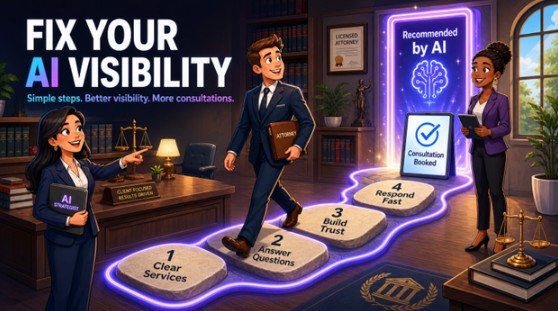
To improve your AI visibility, focus on the basics: make your services clear, answer real client questions, organize your website, keep your information consistent, build trust, and respond quickly when leads come in.
SEO helps people find your firm.
GEO helps AI recommend your firm.
At Authority AI, we help law firms improve AI visibility through GEO and AEO, structure content around real client questions, and build AI-powered systems that help turn more searches into booked consultations.
If you want to know where your firm stands, book a free call with Authority AI. We’ll show you what needs to be fixed, where your visibility can improve, and how to position your firm to get chosen.