May 22, 2026 Allen Levin
Your law firm website was probably built for traditional search. It may have a homepage, practice area pages, attorney bios, a contact form, and a few blogs. For years, that was enough to compete for visibility on Google. But the way potential clients search is changing.
Today, people are not only typing keywords into search engines. They are asking AI tools direct questions like, “Who is the best personal injury lawyer near me?” or “What should I do after a car accident?” or “Do I need an attorney if the insurance company already contacted me?”
That means your website needs to do more than look professional. It needs to be structured in a way that AI tools can understand, trust, and connect to the right questions. If your website is vague, too generic, or poorly organized, AI may struggle to understand what your firm does and when it should recommend you.
This is where GEO and AEO services become important. GEO helps your firm improve visibility in AI-driven search, while AEO helps your website answer the questions potential clients are already asking.
AI tools do not read your website like a person casually browsing pages. They look for clarity, context, consistency, and helpful answers. If your website only says things like “experienced attorneys,” “trusted legal team,” or “client-focused representation,” that may sound professional, but it does not give AI enough useful information.
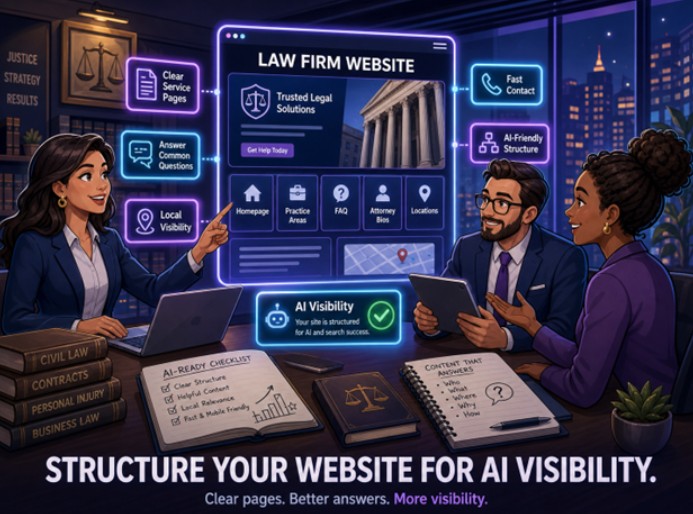
A stronger website structure makes it clear what practice areas your firm handles, what locations you serve, what problems your clients are facing, and what next step they should take. The easier your website is to understand, the easier it becomes for AI tools to connect your firm with relevant searches.
For example, a potential client searching for help after a car accident is not just looking for a firm that says “personal injury.” They want to know what to do next, whether they have a case, how the process works, and how quickly they can speak with someone. Your website should answer those questions clearly.
Your homepage should quickly explain who your firm helps, what legal services you provide, and why someone should trust you. It should not be filled with broad language that sounds good but says very little.
Instead of saying, “We provide trusted legal representation for clients in difficult times,” a stronger version would be, “We help injury victims, families, and individuals in South Florida navigate personal injury, car accident, and insurance-related legal claims.”
That second version is stronger because it gives both people and AI more context. It explains who the firm helps, where the firm operates, and what types of legal problems it handles. A homepage like this makes it easier for AI to understand your firm’s relevance and easier for potential clients to know whether they are in the right place.
One of the biggest mistakes law firms make is placing too many services on one general page. A page called “Legal Services” that lists personal injury, family law, immigration, criminal defense, and estate planning may be convenient, but it does not help AI understand the depth of your expertise.
Each major practice area should have its own dedicated page. A personal injury page should focus only on personal injury. A car accident page should focus specifically on car accident claims. A workers’ compensation page should focus on workers’ compensation. The more specific the page is, the easier it becomes for AI to understand when that page is relevant.
A strong car accident page, for example, should explain what someone should do after an accident, when they should contact an attorney, what evidence matters, how insurance companies usually respond, and what happens during a consultation. This type of content helps potential clients feel informed and gives AI more useful information to work with.
AI search is heavily shaped by questions. People do not always know the exact legal service they need. They usually start by describing their problem or asking what they should do next.
That is why question-based content is so important. Instead of only writing broad blogs like “Why Hire a Personal Injury Lawyer,” law firms should create content around specific questions clients are already asking. A better approach would be to answer questions like “What should I do after a car accident?” or “How long do I have to file a personal injury claim?” or “What happens during a free legal consultation?”
This type of content works because it is helpful for people and easier for AI tools to use when generating answers. It also positions your firm as a trusted source before the client ever contacts you.
Every important page on your website should have one clear purpose. If a page about car accident claims suddenly shifts into medical malpractice, family law, and estate planning, it becomes harder for both people and AI to understand.
A stronger page starts with the client’s problem, explains how your firm helps, answers common questions, describes the process, and makes the next step clear. This structure keeps the content focused and helps visitors move from confusion to action.
The goal is not to write robotic content. The goal is to make your website so clear that both humans and AI understand exactly when your firm should be recommended.
Attorney bio pages are often underused. Many law firm websites treat them like resumes by listing education, awards, memberships, and credentials. That information is valuable, but it does not always explain how the attorney helps clients.
For AI visibility, attorney bios should connect credentials with client relevance. A strong bio should explain the attorney’s practice focus, the types of cases they handle, their approach to working with clients, and the location they serve.
Instead of only saying, “John Smith is an experienced attorney with 15 years of legal experience,” a stronger version would be, “John Smith represents clients in car accident and personal injury cases, helping injured individuals understand their options, deal with insurance companies, and pursue fair compensation.”
That version is more helpful, more specific, and easier for AI to understand.
Local visibility matters for law firms. If your firm serves multiple cities or regions, your website should make that clear.
A general statement like “we serve clients throughout Florida” is helpful, but it may not be enough for specific AI-driven searches like “best car accident lawyer in Fort Lauderdale” or “immigration attorney near Miami.”
Location-specific pages can help AI connect your firm to the areas you serve. These pages should not be thin or duplicated. They should explain the service offered in that location, the type of client you help, and why your firm is relevant to that area.
For example, a page for “Personal Injury Lawyer in Fort Lauderdale” should do more than repeat the city name. It should explain the legal problem, the process, the local relevance, and how the firm helps people in that area.
FAQ sections should not be filler. They should answer the questions potential clients are likely to ask before contacting your firm.
Weak FAQs usually sound generic, like “Why choose our firm?” or “Do you offer legal help?” Strong FAQs answer real decision-making questions, such as “How soon should I contact a lawyer after an accident?” or “What happens during the first consultation?” or “What information should I bring?”
For GEO and AEO, useful FAQs are powerful because they give AI direct answers to pull from. They also help potential clients feel more confident because they get clarity before making the next move.
AI visibility is important, but visibility alone does not bring clients. Once someone finds your firm, your website needs to guide them toward action.
That means every important page should make the next step obvious. The visitor should know whether to call, book a consultation, ask a question, or start an intake process.
For law firms, response time matters. Potential clients are often stressed, uncertain, and comparing multiple attorneys. If your firm takes too long to respond, they may contact another attorney first.
This is where an AI chatbot or AI voice agent can help. These tools can answer common questions, capture lead information, and move potential clients toward a consultation faster. The goal is not to replace your team. The goal is to make sure qualified leads are not missed before your team can respond.
A strong law firm website should not feel like a collection of disconnected pages. It should guide the client from question to confidence to action.
A potential client asks a question. AI finds clear content from your firm. The visitor lands on a relevant page. The page answers their concern. The next step is easy. The lead is captured. The consultation is booked.
That is the website structure law firms need now.
Your content, technical setup, intake process, and follow-up should all support the same journey. This is where AI Business Consulting can help. The right strategy connects your visibility, website structure, automation, and lead response into one system.
If your website is vague, generic, or poorly organized, AI has less reason to recommend your firm. But if your website clearly explains your services, answers real client questions, supports local visibility, and makes the next step simple, your firm becomes easier to understand and easier to choose.
SEO helped law firms compete for rankings. GEO helps law firms compete for recommendations.
At Authority AI, we help law firms and service-based businesses improve AI visibility through GEO and AEO, structure content around real customer questions, and build AI-powered systems that turn visibility into booked consultations.
If you want to understand how your website performs in AI search, book a free call with Authority AI. We’ll show you where your structure, visibility, and response process can improve so your firm is better positioned to be found, understood, and chosen.