
November 14, 2025 Allen Levin
Building an AI Center of Excellence (CoE) helps an organization move from scattered experiments to a structured, scalable AI strategy. It creates a central hub that aligns AI projects with business goals, ensures governance, and builds internal expertise. An effective AI CoE drives consistent, measurable value by combining strong leadership, clear processes, and shared best practices.
Many companies start AI initiatives without a clear plan, leading to wasted resources and limited results. A well-designed CoE avoids this by setting standards, guiding teams, and promoting collaboration between technical and business units. It also helps identify the right opportunities for AI, ensuring that each project supports the organization’s long-term strategy.
A successful CoE focuses on building trust, maintaining compliance, and encouraging continuous learning. When done right, it becomes a sustainable framework that supports innovation while reducing risk.
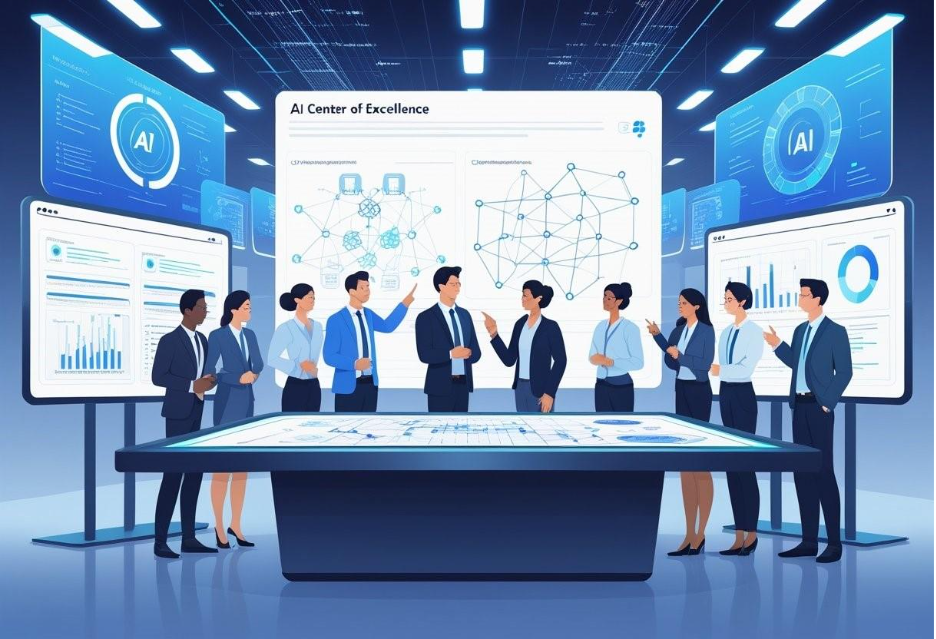
An AI Center of Excellence (CoE) serves as the central hub for guiding, managing, and scaling artificial intelligence across an organization. It defines how AI supports business goals, coordinates expertise, and ensures that technology use remains ethical, efficient, and aligned with enterprise priorities.
A successful AI CoE begins with specific, measurable objectives that define its purpose and value. These goals often include improving decision-making, automating key processes, or enabling data-driven innovation.
Leaders should outline both short-term outcomes—such as developing pilot projects—and long-term goals, like building enterprise-wide AI capabilities.
Clear objectives prevent fragmented efforts and help teams prioritize projects that deliver measurable impact.
A simple framework for defining objectives might include:
| Focus Area | Example Objective |
| Efficiency | Reduce manual reporting time by 30% |
| Innovation | Launch 3 new AI-driven products in 12 months |
| Governance | Establish AI ethics and compliance standards |
By linking goals to business outcomes, the CoE can demonstrate tangible value and maintain leadership support.
An AI CoE requires participation from a diverse group of stakeholders who represent both technical and business perspectives. These often include data scientists, IT leaders, compliance officers, and department heads.
Each stakeholder brings a unique role:
Regular communication and shared accountability help maintain alignment.
Creating a stakeholder map that defines responsibilities and decision-making authority ensures that all contributors understand their roles and how they support the CoE’s mission.
The AI CoE must operate within the broader strategic direction of the organization. Its initiatives should directly support business priorities, such as improving customer experience, reducing costs, or driving innovation.
To achieve alignment, leaders should integrate AI planning into existing business and technology strategies. This includes reviewing corporate goals, identifying relevant metrics, and ensuring that AI investments complement ongoing digital transformation efforts.
When the CoE’s roadmap mirrors organizational strategy, it gains stronger executive backing, clearer funding pathways, and better adoption across departments.

A strong AI Center of Excellence depends on skilled people, clear leadership, and defined rules for how work gets done. Each part of the structure should support collaboration, transparency, and measurable results.
An effective AI CoE team includes experts from multiple disciplines. It combines data scientists, engineers, business analysts, IT specialists, and compliance officers. This mix ensures that AI projects align with both technical standards and business goals.
Organizations often use a hub-and-spoke model, where the central AI team supports business units with tools, training, and governance. This setup helps scale AI adoption while maintaining consistency.
It is important to select team members who can translate business needs into technical solutions. Candidates should also understand data ethics, model validation, and operational constraints.
A balanced team might include:
| Role | Primary Focus |
| Data Scientist | Model design and validation |
| ML Engineer | Deployment and scaling |
| Business Analyst | Use case definition |
| IT/Cloud Specialist | Infrastructure and security |
| Compliance Officer | Risk and policy alignment |
Leadership defines the CoE’s direction and ensures accountability. A CoE Director or Lead typically oversees strategy, funding, and alignment with enterprise priorities. They report to senior executives or a steering committee that provides sponsorship and resources.
Supporting roles may include AI Program Managers, who coordinate projects, and Technical Leads, who set coding and model standards. These leaders guide teams through project selection, development, and deployment.
Clear leadership roles prevent duplication of effort and help manage expectations between departments. Regular communication between leaders and stakeholders keeps projects aligned with business outcomes and compliance requirements.
Governance ensures that AI projects follow consistent rules and ethical standards. The CoE should establish decision-making frameworks that define who approves models, data sources, and deployments.
Typical governance includes:
Decision rights must be explicit. For example, data teams handle technical validation, while business leaders confirm value and risk alignment.
Regular reviews and feedback loops help track performance and adjust priorities. This structure builds trust, reduces risk, and ensures that AI initiatives deliver measurable business impact.

Strong standards help teams build reliable, secure, and ethical AI systems. Clear development rules, strict data controls, and responsible use policies reduce risk and improve consistency across projects.
Teams should follow a structured process for building and testing AI models. This includes setting clear objectives, defining measurable success metrics, and documenting design choices. Using shared templates and version control ensures models remain traceable and reproducible.
A good practice is to maintain a model registry that tracks datasets, algorithms, and performance results. This record helps teams compare outcomes and identify errors early.
Model validation should include both technical accuracy and business relevance. Testing models with real-world data before deployment helps confirm reliability. Regular code reviews and peer evaluations also strengthen quality control.
| Step | Purpose | Example |
| Data prep | Ensure quality inputs | Remove duplicates |
| Model training | Build reliable patterns | Use cross-validation |
| Evaluation | Measure accuracy and fairness | Compare with baseline |
Data governance defines how data is collected, stored, and used. Organizations should classify data by sensitivity and apply access controls that match risk levels. Encryption and anonymization help protect personal or proprietary information.
A central data catalog supports transparency by showing where datasets come from and how they are used. Teams can use audit trails to track who accessed or modified data.
Regular security assessments detect vulnerabilities before they cause harm. AI CoEs often set internal policies that align with privacy laws such as GDPR or CCPA. Training staff on secure handling practices reinforces compliance and reduces human error.
Responsible AI focuses on fairness, transparency, and accountability. Teams should test for bias in both data and model outputs. When issues appear, they must document the cause and corrective steps.
Ethical review boards or committees can evaluate high-impact projects. These groups ensure decisions about automation, privacy, and human oversight meet company and legal standards.
Clear communication about how AI systems make decisions builds trust. Sharing explainability reports and user documentation helps stakeholders understand model behavior. Regular monitoring after deployment ensures ethical principles remain active throughout the AI lifecycle.

An AI Center of Excellence (CoE) succeeds when employees understand how to apply AI tools and share lessons across business units. Building clear learning paths, promoting cross-team collaboration, and maintaining open communication help the organization use AI effectively and consistently.
A strong training program helps employees gain the skills needed to apply AI in their daily work. The CoE should assess current skill levels and identify gaps in areas such as data literacy, machine learning basics, and AI ethics.
Training can include short workshops, online courses, and mentoring. Combining structured learning with hands-on projects helps teams apply new knowledge quickly.
A tiered approach works best:
| Level | Focus | Example Activities |
| Beginner | Awareness and basic AI concepts | Intro sessions, recorded demos |
| Intermediate | Applying AI tools | Guided projects, coding labs |
| Advanced | Model design and optimization | Research collaborations, hackathons |
Regular assessments ensure training stays relevant as technology and business needs evolve.
AI projects often require input from IT, data science, and business units. The CoE should create cross-functional working groups that bring these teams together to define objectives, share insights, and align priorities.
Collaboration improves when teams use shared frameworks and documentation. This reduces duplicated effort and ensures consistent quality.
Practical ways to support collaboration include:
These steps help teams learn from one another and apply proven methods across the organization.
Clear communication keeps everyone informed about AI goals, progress, and outcomes. The CoE should maintain open channels that reach both technical and non-technical staff.
Common tools include internal newsletters, AI dashboards, and community forums. These tools help track results, highlight success stories, and share updates on new tools or standards.
Regular town halls or Q&A sessions allow employees to ask questions and provide feedback. Transparent communication builds trust and encourages wider adoption of AI practices.
Organizations often fail to realize that an AI Center of Excellence (CoE) is not just a technical team. It requires structured change management, ongoing learning, and close alignment with business operations to deliver measurable value.
Many teams underestimate how much organizational change an AI CoE introduces. Employees may resist new workflows, data-driven decision-making, or automation tools. Without a clear communication plan, this resistance slows adoption.
A strong change management strategy includes:
Leaders should involve stakeholders early and show how AI supports their work rather than replaces it. When people understand the benefits and feel supported, adoption improves, and projects face fewer delays.
Ignoring change management often leads to isolated AI projects and poor collaboration between technical and business teams. A structured approach ensures that cultural readiness matches technological progress.
Some organizations treat the CoE as a one-time project instead of a living system. AI models, tools, and governance frameworks must evolve as technology and business needs change.
A sustainable CoE sets up feedback loops to monitor performance, collect lessons learned, and update best practices. Regular reviews help identify what works and what needs adjustment.
Teams should track metrics such as model accuracy, project ROI, and user satisfaction. Documenting these insights builds institutional knowledge and prevents repeated mistakes.
Without continuous improvement, an AI CoE risks becoming outdated or misaligned with the company’s goals. Active learning and iteration keep the CoE relevant and effective.
A CoE that operates in isolation often struggles to deliver real business value. AI success depends on deep collaboration between technical experts and business leaders.
Integration ensures that AI projects solve real problems and align with strategic priorities. CoEs should embed liaisons or cross-functional teams within departments to translate business needs into technical solutions.
Regular joint planning sessions help maintain alignment and accountability. When business units co-own projects, adoption and impact increase.
Failing to integrate leads to duplicated efforts, mismatched priorities, and limited scalability. A connected approach ensures that the CoE drives enterprise-wide transformation rather than isolated innovation.
An AI Center of Excellence (CoE) depends on clear structure, measurable goals, and strong leadership. Its success relies on governance, stakeholder support, and the ability to adapt to new technologies while avoiding fragmented or poorly managed AI efforts.
What are the essential components of an AI Center of Excellence?
An effective AI CoE includes strategy, governance, talent, and technology infrastructure. It brings together data scientists, engineers, and business leaders to align AI projects with company goals.
It also provides shared tools, standardized methods, and training programs that help teams apply AI responsibly and efficiently across the organization.
What common pitfalls should organizations avoid when establishing an AI CoE?
Organizations often fail when they launch a CoE without executive sponsorship, clear objectives, or sustainable funding.
Other common mistakes include focusing too much on technology instead of business outcomes, neglecting governance, and failing to communicate the CoE’s purpose to other departments.
How can businesses measure the success of their AI Center of Excellence?
They can track success through key performance indicators (KPIs) such as project completion rates, model accuracy, cost savings, and adoption levels across teams.
Regular reviews help ensure that AI initiatives deliver measurable business value rather than isolated technical achievements.
What strategies are effective for securing stakeholder buy-in for an AI CoE?
Leaders should link the CoE’s goals to strategic business priorities and demonstrate early wins through pilot projects.
Clear communication, transparent reporting, and collaboration with department heads help build trust and long-term support.
How does an AI Center of Excellence evolve with changing technology trends?
A mature CoE stays current by evaluating new AI tools, frameworks, and compliance standards.
It updates its practices as technologies like generative AI, automation, and advanced analytics mature, ensuring continued relevance and competitiveness.
What role does governance play in the operation of an AI Center of Excellence?
Governance defines standards, accountability, and ethical guidelines for AI use.
It ensures compliance with data privacy laws, manages risk, and promotes consistent quality across projects. Strong governance helps maintain trust and transparency in all AI initiatives.