September 5, 2025 Allen Levin
Most businesses focus on SEO to bring in traffic, but search is changing fast. Voice assistants, AI-driven platforms, and new search formats now play a big role in how people find information. That’s where AEO (Answer Engine Optimization) and GEO (Generative Engine Optimization) come in. Together, AEO and GEO strengthen visibility across voice search, AI tools, and traditional search, which drives more organic traffic from multiple sources.
AEO makes content easy for search engines and voice assistants to pull into quick answers, while GEO ensures that AI-driven platforms like ChatGPT or Bard can surface a brand in generated responses. When these two strategies work side by side, they cover both the direct answers people want and the deeper context AI tools provide. This combination expands reach and builds stronger visibility across the evolving search landscape.
AEO and GEO both extend the role of SEO by focusing on how people search and how search engines deliver results. They target specific needs: AEO improves visibility in voice and AI-driven answers, while GEO strengthens local reach and relevance. Together, they help businesses meet users across different platforms and contexts.
Answer Engine Optimization (AEO) focuses on making content easy for search engines and AI systems to interpret and deliver as direct answers. Unlike traditional SEO, which often targets rankings on results pages, AEO aims to secure positions in featured snippets, voice search, and AI-generated responses.
AEO requires structured data, clear formatting, and concise language. For example, using schema markup helps search engines understand context, while bullet points and FAQs improve the chance of being selected as an answer.
Key benefits of AEO include:
By focusing on precision and clarity, AEO ensures that businesses stay relevant in environments where users expect quick, direct answers.
Generative Engine Optimization (GEO) is designed for AI-driven tools that create answers instead of listing links. Unlike AEO, which targets structured responses, GEO focuses on how content appears in generative results from platforms like ChatGPT or Google’s AI Overviews.
GEO strategies involve optimizing for context, depth, and trust signals. This means producing well-sourced, accurate content that AI systems can confidently use. Businesses that apply GEO gain visibility even when users never visit a traditional search results page.
Important GEO practices include:
By aligning with how AI tools generate responses, GEO helps companies maintain visibility in a changing search environment.
SEO, AEO, and GEO serve different but connected purposes. SEO improves rankings in traditional search engines. AEO increases chances of being chosen for quick answers in voice or snippet-based results. GEO positions content for inclusion in AI-generated responses.
| Approach | Main Goal | Best For |
| SEO | Rank higher in search results | Organic traffic from Google and Bing |
| AEO | Capture direct answers | Voice search, featured snippets |
| GEO | Appear in AI-generated content | Generative AI platforms |
When used together, these strategies ensure visibility across search engines, voice assistants, and AI-driven tools. This creates a more complete approach to capturing organic traffic.
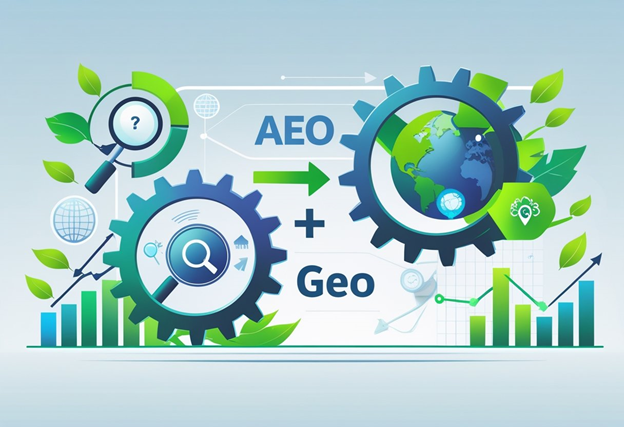
AEO and GEO focus on different parts of search visibility but complement each other when used together. AEO improves how content answers user questions directly, while GEO ensures that content is discoverable in AI-generated responses and conversational platforms.
Answer Engine Optimization (AEO) helps websites appear in voice search, featured snippets, and zero-click results by structuring content for direct answers. Generative Engine Optimization (GEO) adapts content for AI-driven platforms like ChatGPT or Bing Copilot, where responses are generated rather than listed as links.
When combined, AEO and GEO expand reach across multiple search environments. AEO ensures content ranks well in traditional and voice-based searches, while GEO makes sure the same content is visible in AI-generated summaries.
This dual approach allows businesses to meet users where they search—whether on Google, Alexa, or an AI chatbot. By aligning content with both answer engines and generative systems, websites can secure visibility across more digital touchpoints.
Using AEO and GEO together increases the chances of capturing organic visibility in different formats. AEO provides structured answers through schema markup, FAQs, and concise explanations. GEO adapts content for AI systems that pull from multiple sources to generate conversational responses.
The combination improves search coverage by targeting both traditional search engines and AI-powered tools. It also builds brand authority, as content optimized for direct answers and AI summaries positions a site as a trusted source.
Another benefit is future-proofing. Search behavior is shifting toward AI-driven platforms, and GEO ensures that websites remain visible in this environment. When paired with AEO, businesses can maintain strong performance in existing search engines while preparing for new discovery channels.
AEO and GEO together can increase website traffic by capturing user attention at multiple entry points. AEO brings clicks from featured snippets, “People Also Ask” boxes, and voice queries. GEO supports traffic from AI-driven tools that often recommend links within their generated answers.
Traffic growth depends on providing content that is both structured and context-rich. AEO handles the structured part by using clear headings, schema, and FAQs. GEO ensures that content is written in a way that AI can interpret and present naturally in conversation.
By combining these methods, businesses can drive consistent traffic even as search platforms evolve. This creates more opportunities to attract visitors who may not find the site through traditional search alone.
Driving organic traffic with AEO and GEO requires a mix of technical and content strategies. For AEO, businesses should:
For GEO, the focus shifts to:
Together, these steps align content with both search engines and AI platforms. This alignment makes it easier for users to discover and engage with a site, supporting long-term organic traffic growth strategies in 2025 and beyond.
Businesses can strengthen their online visibility by combining answer-focused content with AI-driven optimization and local targeting. This approach helps them appear in direct answers, AI-generated results, and location-based searches, which together drive more consistent organic traffic.
Answer Engine Optimization (AEO) focuses on providing clear, direct responses to user questions. Search engines and AI tools often pull these answers into featured snippets or voice responses. To succeed, businesses should write concise explanations and structure content with headings, lists, and tables.
Using schema markup improves the chances of being recognized as the best answer. For example, FAQ schema can help content appear in rich results. Structured data also helps AI systems understand context and intent.
Another key tactic involves anticipating common questions. Businesses can analyze customer inquiries, keyword suggestions, and “People Also Ask” boxes to identify what users want to know. Creating content that addresses these questions increases the likelihood of visibility in answer-focused search.
Generative Engine Optimization (GEO) aims to influence how AI models summarize and present information. Unlike AEO, which targets direct answers, GEO ensures brand content is represented in longer AI-generated responses.
To optimize for GEO, businesses should focus on depth and coverage. Content should explain topics thoroughly, include supporting details, and cite credible sources. This increases the chance that AI systems will use the material when generating responses.
Consistency across multiple channels also matters. Publishing accurate, updated information on websites, blogs, and profiles helps AI engines recognize authority. Businesses should also avoid duplicate or thin content, as generative systems prioritize sources that add unique value.
AI-driven SEO combines traditional optimization with strategies tailored for modern search engines. This includes using structured data, optimizing for natural language queries, and improving technical performance such as site speed and mobile usability.
AI tools increasingly interpret search intent, so businesses should create content that matches user needs rather than just keywords. For example, instead of repeating a phrase, they can cover related subtopics that align with the query.
Monitoring performance with AI-powered analytics also helps refine strategy. These tools can identify gaps in coverage, highlight underperforming pages, and suggest new opportunities for targeting answer-based or generative results.
Local SEO becomes stronger when paired with AEO and GEO. While AEO improves visibility in answer-based results, GEO helps ensure local businesses appear in AI-generated summaries. This is especially important in competitive regions such as Florida, where location-specific searches drive a large share of traffic.
Key steps include optimizing Google Business Profiles, adding local schema markup, and using consistent name, address, and phone (NAP) data across listings. Businesses should also create localized content that answers community-specific questions.
Why is GEO important for local SEO? It ensures that AI-driven platforms highlight local businesses in broader responses, not just in maps or directories. Combined with AEO, this helps companies appear in both direct answers and generative results, making them more visible to local customers.
Answer Engine Optimization (AEO) and Generative Engine Optimization (GEO) are reshaping how businesses capture visibility in search. They focus on AI-driven platforms, voice assistants, and generative engines that now deliver direct answers instead of just links. This shift changes how companies plan content, optimize websites, and approach organic traffic growth.
AEO helps brands appear in voice search, featured snippets, and zero-click results. It ensures that when users ask questions, the business provides the most direct and trusted answer. GEO, on the other hand, focuses on visibility in AI-generated responses from tools like ChatGPT and other generative search engines.
Together, they expand reach beyond traditional Google search. Businesses no longer compete only for rankings but also for placement within AI-driven results. This approach is especially useful for industries where quick, concise answers influence customer decisions.
Key benefits include:
Digital marketing consultants in Fort Lauderdale and Miami now integrate AEO and GEO into campaigns to help South Florida businesses stay competitive.
Search engine optimization is no longer limited to keywords and backlinks. The future of SEO includes adapting to conversational AI and generative engines. AEO ensures businesses provide structured, accurate answers, while GEO helps content appear in AI-generated summaries and recommendations.
Companies that invest early in these methods gain an advantage as AI platforms dominate how users find information. For example, a local restaurant in Miami can benefit from AEO by showing up in voice searches like “best Cuban food near me,” while GEO increases its chances of being mentioned in AI-generated travel guides.
This evolution shows that AEO may not replace SEO but instead extend it. Traditional SEO remains relevant, but without AEO and GEO, businesses risk losing visibility as search habits continue to shift.
South Florida businesses, especially in Miami, Fort Lauderdale, and Broward County, are turning to specialized AEO and GEO SEO services. These services help companies adapt their content for both search engines and AI-driven platforms.
A digital marketing consultant in Fort Lauderdale may structure content for voice queries, while Miami AEO and GEO optimization services refine content for generative engines. This dual approach drives organic traffic growth across multiple platforms.
Local experts often provide:
For businesses searching “AEO GEO SEO consultant near me,” South Florida offers agencies skilled in AI-powered SEO strategies. These services help companies maintain visibility across Google, chatbots, and voice assistants, ensuring they stay ahead in a rapidly changing digital landscape.
AEO and GEO focus on different aspects of search optimization but complement each other when used together. They help brands secure visibility in direct answers, local searches, and AI-driven results while adapting to voice and mobile search behaviors.
What are the key differences between AEO (Answer Engine Optimization) and GEO (Geographical Engine Optimization)?
AEO targets answer engines and AI-driven platforms by structuring content so machines can extract clear, direct responses.
GEO focuses on optimizing for generative AI systems that provide synthesized results, often tied to local or contextual information.
How can integrating AEO with GEO strategies improve organic search visibility?
Combining AEO and GEO allows content to appear in both quick-answer formats and AI-generated summaries.
This dual approach ensures visibility across traditional search engines, voice assistants, and generative platforms.
What are the best practices for combining AEO and GEO to enhance local search results?
Use structured data, schema markup, and FAQ sections to support AEO while also including accurate business details and location signals for GEO.
Keeping content consistent across directories, maps, and websites helps maximize local visibility.
How does voice search impact the effectiveness of AEO and GEO in driving organic traffic?
Voice search relies heavily on concise, well-structured answers, making AEO critical for capturing spoken queries.
When paired with GEO, businesses can provide location-specific responses that voice assistants often prioritize.
Can AEO and GEO be effectively leveraged for mobile search optimization?
Yes. Mobile searches often include immediate questions and local intent, which align with both AEO and GEO strategies.
Optimizing for fast-loading pages, clear formatting, and location-based content improves performance on mobile devices.
What role does content relevance play in optimizing for AEO and GEO simultaneously?
Content must be accurate, up to date, and directly aligned with user intent to succeed in both AEO and GEO.
Relevant information helps answer engines extract precise responses while also supporting generative systems in providing trustworthy results.