June 5, 2026 Allen Levin
AI is everywhere right now.
Every week there is a new tool, a new chatbot, a new AI agent, a new automation platform, and a new promise that says, “This will change your business.”
But for restoration and HVAC companies, the real question is not:
“What AI tool should we buy?”
The better question is:
“Where are we losing revenue because our current system is too slow, too manual, or too inconsistent?”
That is where AI should start.
For most restoration and HVAC companies, AI should not begin with content creation, complicated dashboards, or random experiments. It should begin with the parts of the business that directly affect calls, leads, appointments, follow-up, and booked jobs.
Because in local service industries, speed matters. A homeowner with water damage, mold concerns, no AC, or a broken heating system is not casually browsing. They need help, they need clarity, and they usually choose the company that responds fast and gives them the clearest next step.
That is exactly where AI can create the fastest impact.
Google is also changing how customers search. AI Overviews and AI Mode are making search more conversational, with Google explaining that AI features can summarize information and help users explore questions with links to go deeper. Google also says AI Mode can break complex questions into subtopics and search across them at once. That means homeowners are not only typing “HVAC company near me” anymore. They are asking more detailed questions like “What should I do if my AC is blowing warm air?” or “Who should I call first after water damage?”
So the companies that win with AI will not just be the ones using AI internally. They will be the ones that are easier for customers and AI search engines to understand, trust, contact, and book.
At Authority AI, this is why we recommend a revenue-first approach to AI implementation.
Not more tools.
Not more complexity.
A clearer system that turns visibility into booked jobs.
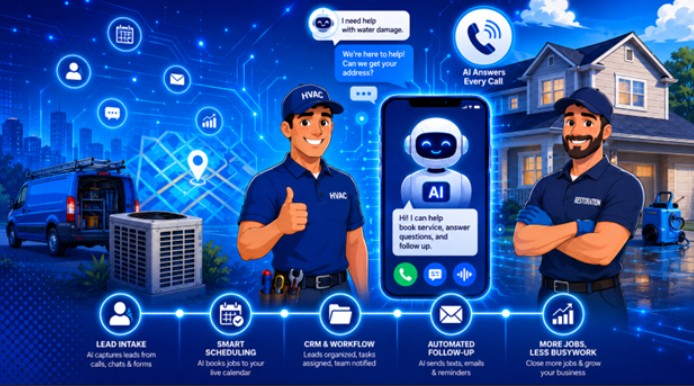
Restoration and HVAC companies should automate these areas first:
The order matters.
A company should not start by automating random internal tasks if leads are still being missed, calls are going unanswered, and follow-ups are inconsistent.
The first priority should be any process that affects whether a customer becomes a booked job.
For restoration and HVAC companies, the phone is still one of the most important sales channels.
A water damage customer does not want to wait until tomorrow morning. A homeowner with a broken AC in summer does not want to leave a voicemail and hope someone calls back. They want to know if someone can help, how soon, and what happens next.
This is why an AI phone system or AI voice agent is one of the best first automations for restoration and HVAC companies.
An AI phone system can help:
Answer calls after hours[Text Wrapping Break] Capture caller information[Text Wrapping Break] Ask basic qualifying questions[Text Wrapping Break] Identify emergency vs non-emergency leads[Text Wrapping Break] Route urgent calls to the right person[Text Wrapping Break] Book appointments or request a callback[Text Wrapping Break] Send call summaries into the CRM
This does not replace the team. It removes the gap between the customer reaching out and the company responding.
That gap is where many jobs are lost.
Research on lead response time has shown that companies that respond quickly have a much better chance of reaching and qualifying leads. The well-known Harvard Business Review research on online sales leads found that many companies were not responding fast enough, and later summaries of the study continue to point to the importance of responding within minutes, not hours.
For local service companies, that matters even more because the customer usually has an urgent problem.
Authority AI service connection:[Text Wrapping Break] Learn more about AI Voice Agents and AI Chatbots.
Many businesses want to use AI for marketing first.
That makes sense on the surface. More visibility means more leads.
But if the intake process is broken, more leads will only create more missed opportunities.
Before increasing ad spend, posting more content, or investing heavily in SEO, restoration and HVAC companies should make sure every lead is captured properly.
An AI intake system can collect:
Name[Text Wrapping Break] Phone number[Text Wrapping Break] Service needed[Text Wrapping Break] Property location[Text Wrapping Break] Emergency level[Text Wrapping Break] Preferred appointment time[Text Wrapping Break] Insurance involvement for restoration jobs[Text Wrapping Break] System type for HVAC jobs[Text Wrapping Break] Photos or details when needed[Text Wrapping Break] Consent for follow-up
For restoration companies, this can help separate true emergency water damage calls from general questions. For HVAC companies, it can help separate repair calls, replacement opportunities, tune-ups, and maintenance plan leads.
That means the team does not waste time chasing unclear leads, and serious opportunities get handled faster.
This is where AI becomes practical. It is not just “automation.” It is better triage.
Once a lead comes in, the next question is simple:
How fast does your company respond?
If someone fills out a website form at 8:30 PM, does your team respond immediately?
If a call is missed during lunch, does the customer get a text or callback workflow?
If someone asks a question through the website chat, does that lead enter your CRM?
If the answer is no, this is one of the first things to automate.
AI follow-up can help send an immediate response like:
“Thanks for reaching out. We received your request and can help. Is this an emergency, or would you like to schedule the next available appointment?”
For restoration, the message could guide the homeowner to take the next safe step while waiting for a call.
For HVAC, the message could help determine whether the customer needs repair, replacement, maintenance, or emergency service.
The point is not to make the customer feel like they are talking to a robot.
The point is to make sure they are not ignored.
Once a lead is qualified, the next bottleneck is often scheduling.
This is where many companies still depend on manual back-and-forth communication.
The customer says they are available tomorrow morning. The team checks the calendar. Someone calls back. The customer misses the call. Now the job is delayed, and another company may already be on the way.
AI can reduce that friction.
A smart booking automation can:
Offer available appointment windows[Text Wrapping Break] Confirm service area[Text Wrapping Break] Assign the lead to the right team member[Text Wrapping Break] Send calendar confirmations[Text Wrapping Break] Notify dispatch or sales[Text Wrapping Break] Update the CRM[Text Wrapping Break] Trigger reminders before the appointment
For HVAC companies, this can help with repair calls, estimates, tune-ups, and replacement consultations.
For restoration companies, this can help route emergency mitigation calls faster and separate them from non-urgent inspections or estimate requests.
This is where AI directly supports revenue.
The faster a qualified customer gets a clear next step, the more likely they are to stay with your company.
A lot of lost revenue does not come from a lack of leads.
It comes from leads falling through the cracks.
Someone forgets to update the CRM. A callback is not logged. A quote is sent but never followed up on. A technician notes something important, but sales never sees it.
AI can help clean this up.
An AI-powered CRM workflow can:
Create new contacts automatically[Text Wrapping Break] Tag leads by service type[Text Wrapping Break] Move opportunities through pipeline stages[Text Wrapping Break] Summarize calls[Text Wrapping Break] Create follow-up tasks[Text Wrapping Break] Notify the right person[Text Wrapping Break] Flag urgent leads[Text Wrapping Break] Track missed calls and abandoned opportunities
This matters because the CRM should not just be a database.
It should be the operating system for revenue.
When AI helps keep the CRM clean, the team can focus on the customer instead of constantly doing admin work.
Restoration and HVAC companies often spend a lot of time creating estimates.
But many estimates never get followed up properly.
This is a major revenue leak.
For HVAC companies, this is especially important for replacement quotes. A customer might be comparing three companies, and the one that follows up clearly and professionally often has the advantage.
For restoration companies, follow-up can matter for reconstruction, mold remediation, insurance-related work, and non-emergency projects.
AI can help by sending follow-up messages like:
“Hi Sarah, just checking in to see if you had any questions about the estimate we sent over. We can help walk you through the next step.”
Or:
“Hi Mike, we still have availability this week if you’d like to move forward with the inspection.”
The best follow-up does not feel pushy. It feels helpful.
AI can make sure it happens consistently.
Reviews are not just a reputation tool anymore.
They are also part of AI visibility.
When homeowners ask AI tools or search engines which company they should trust, your online reputation can influence how your business is understood.
A review automation system can:
Send review requests after completed jobs[Text Wrapping Break] Segment happy customers[Text Wrapping Break] Follow up if no review is left[Text Wrapping Break] Route unhappy customers to internal support first[Text Wrapping Break] Track review volume by location or service[Text Wrapping Break] Help the team collect testimonials and proof
For restoration and HVAC companies, reviews can support both conversion and visibility.
A homeowner is more likely to trust a company with clear proof. AI search systems are also more likely to understand a company when there is consistent information across the website, listings, reviews, and third-party sources.
This connects directly to GEO and AEO.
Authority AI service connection:[Text Wrapping Break] Learn more about GEO and AEO Services.
Many homeowners visit a website before calling.
They may want to know:
Do you offer emergency service?[Text Wrapping Break] Do you handle insurance claims?[Text Wrapping Break] Do you serve my city?[Text Wrapping Break] Do you repair this HVAC brand?[Text Wrapping Break] Do you offer financing?[Text Wrapping Break] How fast can someone come out?[Text Wrapping Break] What should I do before the technician arrives?
If those answers are hard to find, the visitor may leave.
An AI chatbot can help answer common questions, collect lead information, and guide the visitor toward booking.
But the chatbot has to be built correctly.
It should not just say generic things like “How can I help you?”
It should understand the company’s services, service areas, emergency process, booking flow, and customer concerns.
A good AI chatbot for restoration and HVAC should be trained around real customer questions.
For restoration, that may include water damage, mold, fire damage, storm damage, insurance claims, moisture inspections, and emergency response.
For HVAC, that may include AC repair, system replacement, ductwork, indoor air quality, tune-ups, maintenance plans, and financing.
The goal is simple:
Help the customer get an answer and take the next step.
AI automation is not only about operations.
It also affects how your company gets discovered.
Search is becoming more answer-based. Google’s official guidance for AI features says website owners should focus on helpful, reliable, people-first content and make sure technical SEO foundations are solid for AI-powered search experiences. Google also published guidance in May 2026 on how website owners can succeed in generative AI features like AI Overviews and AI Mode.
For restoration and HVAC companies, this means your website should answer the exact questions homeowners are asking.
Examples:
“What should I do immediately after water damage?”[Text Wrapping Break] “How fast should a restoration company arrive?”[Text Wrapping Break] “Does homeowners insurance cover water damage?”[Text Wrapping Break] “Why is my AC running but not cooling?”[Text Wrapping Break] “Should I repair or replace my HVAC system?”[Text Wrapping Break] “How often should I service my AC unit?”[Text Wrapping Break] “What is the best HVAC company near me?”
GEO, or Generative Engine Optimization, helps structure your website so AI tools can better understand your business, services, expertise, and local relevance.
This includes:
Clear service pages[Text Wrapping Break] FAQ sections[Text Wrapping Break] Schema markup[Text Wrapping Break] Local service area content[Text Wrapping Break] Strong internal linking[Text Wrapping Break] Case studies and proof[Text Wrapping Break] Helpful educational content[Text Wrapping Break] Consistent business information[Text Wrapping Break] Answer-focused blog content
This is why AI visibility and AI automation should work together.
If AI helps more people find your company, your intake system needs to convert those opportunities.
If AI helps answer customer questions, your website should provide the right information.
If AI helps generate demand, your CRM and follow-up system should make sure that demand becomes revenue.
Authority AI service connection:[Text Wrapping Break] Explore GEO and AEO Services.
Not every AI project should be first.
Restoration and HVAC companies should usually avoid starting with:
Random AI content tools[Text Wrapping Break] Complicated dashboards no one uses[Text Wrapping Break] Internal automations disconnected from revenue[Text Wrapping Break] AI tools that do not connect to the CRM[Text Wrapping Break] Chatbots with generic answers[Text Wrapping Break] Automated messages with no human handoff[Text Wrapping Break] Marketing campaigns before fixing intake
The danger is not AI itself.
The danger is using AI in the wrong place.
If your company is missing calls, responding slowly, losing estimates, and failing to follow up, then automating social media captions will not solve the real problem.
Start where the money is leaking.
Here is the simple order we recommend.
Start with calls, forms, chats, and missed opportunities.
Make sure every lead is captured, tagged, and followed up with.
Use AI to respond immediately, qualify the lead, and guide the customer to the next step.
Connect AI to calendar, dispatch, CRM, and sales workflows.
Automate estimate follow-up, unbooked lead follow-up, and reactivation campaigns.
Build GEO content, FAQ sections, schema, service pages, and answer-based content so AI search tools can better understand and recommend your company.
This approach keeps AI tied to revenue.
One of the biggest misconceptions about AI is that it is only about replacing people.
For restoration and HVAC companies, the better use of AI is support.
AI can help the team:
Answer faster[Text Wrapping Break] Follow up consistently[Text Wrapping Break] Reduce admin work[Text Wrapping Break] Prioritize urgent leads[Text Wrapping Break] Avoid missed opportunities[Text Wrapping Break] Keep the CRM clean[Text Wrapping Break] Improve the customer experience[Text Wrapping Break] Create a smoother path from inquiry to booking
The owner still matters.
The dispatcher still matters.
The technician still matters.
The sales team still matters.
AI simply helps remove the friction that slows everyone down.
And in industries where timing, trust, and response speed matter, less friction can mean more booked jobs.
So, what should restoration and HVAC companies automate first with AI?
Start with the customer journey.
Automate the moments where leads are most likely to disappear:
When no one answers the phone[Text Wrapping Break] When a form submission sits too long[Text Wrapping Break] When a quote is sent but not followed up[Text Wrapping Break] When the CRM is not updated[Text Wrapping Break] When a customer has questions but cannot find answers[Text Wrapping Break] When a homeowner finds your company but does not know what to do next
That is where AI can create real business impact.
Not as another tool.
As a system that helps turn visibility into booked jobs.
At Authority AI, we help restoration and HVAC companies build AI-ready systems that connect visibility, response, follow-up, and revenue.
If your business is getting leads but losing opportunities because of missed calls, slow follow-up, or unclear systems, it may be time to rethink where AI belongs in your company.
You can explore our AI Business Consulting, AI Phone Systems, AI Chatbots, and GEO/AEO Services.
Or you can book a free call with Authority AI and we’ll help you identify what your business should automate first.
HVAC companies should automate missed call handling, lead intake, appointment booking, follow-up, CRM updates, and estimate follow-up first. These areas directly affect booked jobs and revenue.
Restoration companies should automate emergency call response, lead qualification, dispatch routing, insurance-related intake, CRM updates, and follow-up. Speed matters because many restoration leads are urgent.
Yes. AI can help companies respond faster, capture more leads, follow up consistently, and guide customers toward booking. The best results happen when AI is connected to the phone system, website, CRM, and follow-up process.
Yes. AI is especially useful for local service businesses because many leads are time-sensitive. AI can help answer calls, qualify leads, automate follow-up, and improve the customer experience.
GEO, or Generative Engine Optimization, helps structure a company’s website and content so AI search engines and answer engines can better understand the business, its services, locations, expertise, and trust signals.
Most restoration and HVAC companies should automate revenue operations first. That includes intake, response, booking, follow-up, and CRM workflows. Marketing becomes more valuable when the business has a system that can convert the leads it generates.