
March 20, 2026 Allen Levin
Homeowners no longer rely only on Google. Many now ask tools like ChatGPT and Gemini who to call for AC repair, furnace replacement, or emergency service. If your company does not appear in those answers, you lose jobs before the phone rings.
You must show up in AI search results now, before paid placements like ChatGPT ads become common and push organic visibility lower. When ads enter the space, competition and costs will rise. Building strong organic presence today gives you a clear edge and steady leads without relying only on paid traffic.
AI tools pull from trusted websites, strong reviews, and clear local service pages. If you want steady calls during peak season, you need content that answers real questions, accurate business listings, and proof that you serve your area well. The companies that act now will control more visibility as AI search keeps growing.
Homeowners now use both Google and AI tools to choose HVAC companies. If you do not appear in AI answers before paid placements expand, you risk losing visibility at the moment customers decide who to call.
You no longer compete only for “AC repair near me.”
Homeowners ask full questions like:
Many users type these questions into Google. But a growing number ask them in ChatGPT, Gemini, or other AI tools. Google also shows AI Overviews in a large share of searches, which changes how results appear.
Instead of clicking through several websites, users read one summarized answer. If your company is not mentioned in that summary, you may not get the call.
In 2026, customers find HVAC companies online through:
| Channel | What Customers See |
| Google Search | AI Overviews + map listings |
| Google AI Mode | Conversational answers with citations |
| ChatGPT & Gemini | Ranked recommendations and summaries |
| Business Listings | Reviews and ratings inside AI responses |
You must structure your content, reviews, and listings so AI systems recognize your brand as relevant and trustworthy.
Google still drives more traffic than ChatGPT for HVAC leads. However, AI now shapes a large share of what users see inside Google itself.
AI Overviews appear in many searches. AI Mode allows follow-up questions, which keeps users inside Google’s AI interface instead of sending them to multiple websites.
At the same time, tools like ChatGPT and Gemini act as answer engines. They pull from websites, business profiles, forums, and reviews. They summarize and recommend companies directly.
This shift changes AI search vs Google search in three key ways:
If your HVAC marketing strategy still focuses only on traditional rankings, you miss how homeowners search for HVAC services online in 2026.
ChatGPT Ads and similar paid placements will likely follow the same path as Google Ads. Early adoption will favor companies that already appear in organic AI answers.
If AI tools begin labeling sponsored HVAC recommendations, you will face two realities:
Paid ads often cost more over time as competition increases. If you fail to build organic AI presence now, you may depend on paid placement just to stay visible.
Strong AI visibility gives you leverage. It lowers your reliance on ads and protects your brand when sponsored results expand.
In 2026, AI search visibility is not optional. It directly affects how customers find HVAC companies online and how much you must spend to compete.
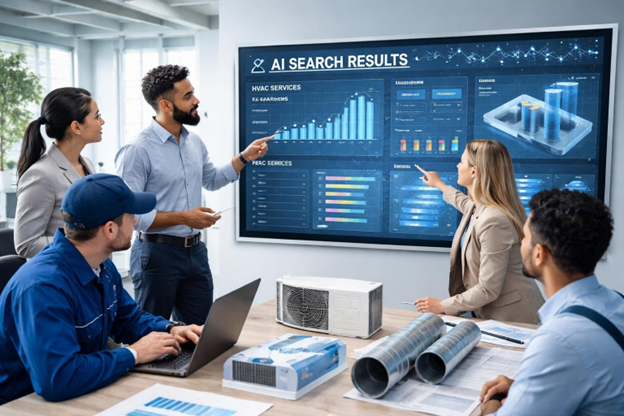
AI tools recommend businesses based on clear data, strong local signals, and trusted brand mentions. You must structure your content for machines, prove local authority, and align with how people ask questions in natural language.
You need structured content for AI search, not long sales pages filled with keywords. AI systems scan for clear answers, service details, and proof of expertise.
Use simple page structures:
Add schema markup for services, reviews, FAQs, and service areas. Structured data helps AI understand what you offer, where you operate, and how customers rate you.
Focus on specific problems:
Answer each query with clear steps, pricing ranges, and timelines. AI visibility strategy depends on clarity, not volume. When your content matches real questions, AI systems can pull your answers into summaries and overviews.
Local SEO for HVAC companies remains critical because most jobs come from a defined service area. AI tools rely on consistent local data to recommend businesses.
Keep your Name, Address, and Phone number (NAP) identical across:
Create city-specific and neighborhood pages with unique content. Avoid copying the same text and swapping city names.
GEO optimization for HVAC means aligning your content with how generative engines evaluate trust. These systems look for:
If Google AI Overviews appear in a large share of searches, your business must send strong local signals. Accurate profiles, recent reviews, and clear service coverage improve HVAC online visibility in both traditional and AI-driven results.
People now search in full sentences. They type or speak questions like, “Why is my heat pump making a loud noise?” or “Who fixes AC units on weekends?”
Conversational search marketing requires you to mirror that behavior. Write content in question-and-answer format. Use headings that reflect natural speech.
For example:
Question: How much does AC repair cost in Tampa?
Answer: Most AC repairs in Tampa range from $150 to $800, depending on parts and labor.
This structure helps AI extract direct responses. It also increases your chances of appearing in AI summaries.
Study your call logs and chat transcripts. Turn real customer questions into content topics. When you match how AI recommends businesses—based on relevance and clarity—you improve how to get more HVAC leads without relying only on ads.
AI systems evaluate reputation before recommending a company. They scan reviews, third-party mentions, and overall sentiment.
Build authority through:
Ask customers to describe the job performed, such as “ductless mini-split install” or “emergency furnace repair.” Specific language strengthens your association with those services.
Monitor and respond to every review. Clear, professional responses show active management.
Strong brand mentions combined with structured content and local authority increase the likelihood that AI includes your company in answers, summaries, and recommendations before paid options like ChatGPT Ads become common.
To rank in AI search, you must control how AI tools read, verify, and describe your HVAC business. Focus on clear brand signals, structured data, and visible proof of expertise.
If you want to appear in ChatGPT results, you need strong digital signals across many platforms. AI tools pull from websites, business listings, reviews, forums, and trusted media sources.
Start with your Google Business Profile, Yelp, Facebook, and BBB listings. Keep your name, address, and phone number consistent. Ask customers to leave detailed reviews and respond to each one.
Create AI content for service businesses that answers real questions. Write pages like:
AI systems often break one prompt into many smaller searches. If your site ranks for those related terms, you improve your chances of getting recommended by ChatGPT.
Engage in public spaces such as Reddit or local forums without sounding promotional. Clear mentions of your brand in trusted discussions increase your visibility in AI summaries.
If ChatGPT ads become common for local businesses, organic visibility will still matter. Paid placements may highlight options, but AI tools still rely on trusted data when choosing who to mention.
You must help AI systems understand your content. Schema and structured data make your website easier to read for both search engines and AI models.
Add LocalBusiness, HVACBusiness, Service, FAQ, and Review schema to key pages. Include service areas, hours, pricing ranges, and customer ratings in structured format.
Use FAQ sections that answer specific service questions in plain language. Mark them with FAQ schema so AI tools can extract clean answers.
You should also:
Clear structure supports how to optimize your HVAC website for AI search. It improves your chances of being cited in AI Overviews and AI chat responses.
When AI tools for HVAC businesses scan your site, they look for organized, consistent data. Structured content increases your eligibility for AI-powered recommendations and citations.
AI systems favor businesses that show real expertise and proof of work. You need visible signals of experience, authority, and trust.
Showcase completed HVAC jobs with photos, dates, and service details. Add technician bios with licenses and certifications. List manufacturer partnerships and years in business.
Build backlinks from local news sites, trade groups, and community organizations. Strong domain authority still influences how to rank in AI search.
Trust also comes from behavior. Respond to reviews. Publish clear contact details. Avoid keyword stuffing or thin pages.
If you want to get HVAC leads from AI search, you must make it easy for AI systems to verify you. When your brand appears often in trusted sources and your website shows proof of real work, AI platforms are more likely to recommend you.
AI tools already shape how homeowners choose HVAC contractors. You need a plan that connects organic AI visibility with paid placement while you adjust to fast changes in search behavior.
You should treat AI search visibility and paid ads as one system, not two separate channels. Organic presence builds trust, and paid placement protects your brand when competition increases.
Start with clear service pages for high‑value work:
AI systems pull from this content when they suggest companies. If your pages lack detail, paid ads will cost more because you rely only on bidding, not credibility.
As ChatGPT ads and other AI-sponsored placements grow, expect higher competition for emergency keywords. Prepare now by:
This mix reflects the best marketing strategies for HVAC companies in 2026. You earn AI recommendations first, then use paid ads to expand reach during peak season.
Homeowners no longer follow a simple “Google, click, call” path. Many ask AI tools direct questions like “Who can fix my AC today in [city]?” You must optimize for answers, not just rankings.
Focus on structured, direct content. Use simple headings such as:
Give clear ranges and explain factors that affect price. Avoid vague claims like “quality service.” AI systems prefer specific facts.
Track how AI platforms describe your business. Check:
These actions align with major HVAC marketing trends 2026, where visibility depends on clarity, consistency, and proof. If you adapt early, you position your company for the future of HVAC marketing instead of reacting after paid AI placements dominate.

AI tools now shape how homeowners research HVAC services, compare brands, and choose contractors. You need to understand how AI affects systems, service, marketing, and long-term maintenance if you want to stay visible before paid AI ads dominate results.
How does artificial intelligence enhance the effectiveness of HVAC systems?
AI improves how HVAC systems run inside homes and commercial buildings. Smart thermostats and connected sensors track temperature, humidity, and usage patterns in real time.
You can use AI-driven controls to adjust airflow and output based on actual demand, not fixed schedules. This reduces energy waste and keeps indoor conditions stable.
Some systems also detect performance issues early. They alert you or the homeowner before small problems turn into major repairs.
What advancements in AI technology are most impactful for the HVAC industry?
Machine learning has made predictive maintenance more accurate. Systems now analyze large sets of performance data to spot patterns linked to failure.
Voice search and AI assistants also change how customers find you. Many homeowners now ask full questions like, “Why is my AC blowing warm air?” instead of typing short keywords.
AI search summaries and chat-based tools pull answers from trusted sources. If your content clearly explains services, pricing, and service areas, you increase your chances of being cited.
In what ways can HVAC companies leverage AI to improve their customer service?
You can use AI chatbots on your website to answer common questions 24/7. These tools can book appointments, collect contact details, and route urgent requests.
AI-powered scheduling tools help you assign jobs based on location, technician skill, and urgency. This reduces delays and improves response times.
Call tracking systems with AI transcription also show you what customers ask most. You can use that data to improve scripts, FAQs, and training.
What should HVAC businesses consider when adopting AI for their marketing strategies?
You should focus on visibility in AI-generated answers before investing in paid placements. That means keeping your Google Business Profile complete and accurate.
Add structured data to your website so search engines understand your services, locations, and hours. Clear FAQ content helps AI tools extract direct answers.
You also need consistent business information across directories like Yelp, Bing Places, and industry listings. AI systems cross-check this data before recommending a company.
How will AI influence the future of HVAC maintenance and diagnostics?
AI will shift maintenance from reactive to predictive. Systems will monitor performance daily and flag unusual patterns.
You can use remote diagnostics to review system data before arriving on site. This helps you bring the right parts and reduce repeat visits.
Over time, customers may expect service plans that include data monitoring, not just annual inspections.
Can AI-driven tools provide a competitive edge for HVAC companies in digital marketing?
AI-driven search tools often deliver a single recommended provider instead of a long list. If you appear in that answer, you gain strong visibility without paid ads.
Visitors who come from AI-generated recommendations often show high intent. They usually ask detailed questions and request quotes quickly.
If you prepare now by optimizing your profiles, content, and technical data, you strengthen your position before AI ad platforms become crowded and more expensive.