
December 18, 2025 Allen Levin
Telecom companies rely on instant, reliable communication, and low-latency voice AI makes that possible. Low-latency voice AI allows real-time speech interactions that sound natural, respond instantly, and reduce the awkward pauses often found in automated systems. By combining automatic speech recognition, large language models, and text-to-speech systems, telecom providers can deliver smoother, faster, and more human-like experiences.
Behind this speed lies a well-tuned AI voice pipeline built to handle input, process responses, and return speech in milliseconds. Each part—from detecting when someone starts talking to generating the AI’s spoken reply—works together in a continuous loop designed for minimal delay. This setup enables large-scale telecom operations, like customer support or interactive voice systems, to handle conversations at human speed.
As AI-powered telecom systems evolve, low-latency voice technology sets the foundation for more natural customer interactions. It transforms how networks, infrastructure, and AI models connect to create instant, reliable communication across global platforms.

Low-latency voice AI allows telecom systems to respond in less than a second, keeping customer interactions natural and immediate. It enables real-time speech recognition, reasoning, and response generation, improving call quality and user satisfaction in automated communication systems.
Low-latency voice AI refers to systems designed to understand and reply to human speech almost instantly. In telecom contexts, latency under 300 milliseconds is often considered the benchmark for natural conversations. This timing mimics how people pause and respond in live dialogue, reducing awkward silences and improving the perceived intelligence of AI agents.
These systems depend on end-to-end pipelines that include three main stages:
Efficient integration of these components ensures quick turnarounds without skipping accuracy. Telecom companies use optimized models, lighter architectures, and edge computing to keep latency as low as possible, even under heavy network loads.
Traditional telecom systems rely on interactive voice response (IVR) menus and pre-recorded prompts. These static systems often lead to repeat inputs and long wait times. In contrast, voice AI enables dynamic, conversational exchanges that adapt to each user’s intent.
| Feature | Traditional IVR | Voice AI |
| Response Method | Pre-recorded prompts | Real-time generated speech |
| Flexibility | Limited to fixed scripts | Adapts to natural speech |
| Latency | Noticeable delays | Sub-second responses |
| Learning Ability | None | Improves with data |
Voice AI supports personalized and context-aware handling of calls, eliminating the frustration of rigid menu trees. It also reduces the need for human agents on routine queries, helping telecom operators maintain quality service while managing costs.
Real-time processing ensures that each stage—speech input, understanding, and output—occurs continuously rather than in separate steps. Telecom-grade systems use streaming ASR and concurrent processing to shorten round-trip times.
This approach prevents pauses between caller and AI, making interactions sound smooth and human-like. Telecom infrastructure must handle network jitter, signal compression, and packet loss without adding delay.
Technologies such as edge computing and model quantization further improve efficiency by processing audio closer to users and minimizing computational overhead. Together, these methods allow telecom AI systems to respond instantly, supporting fast, reliable, and natural communication at scale.
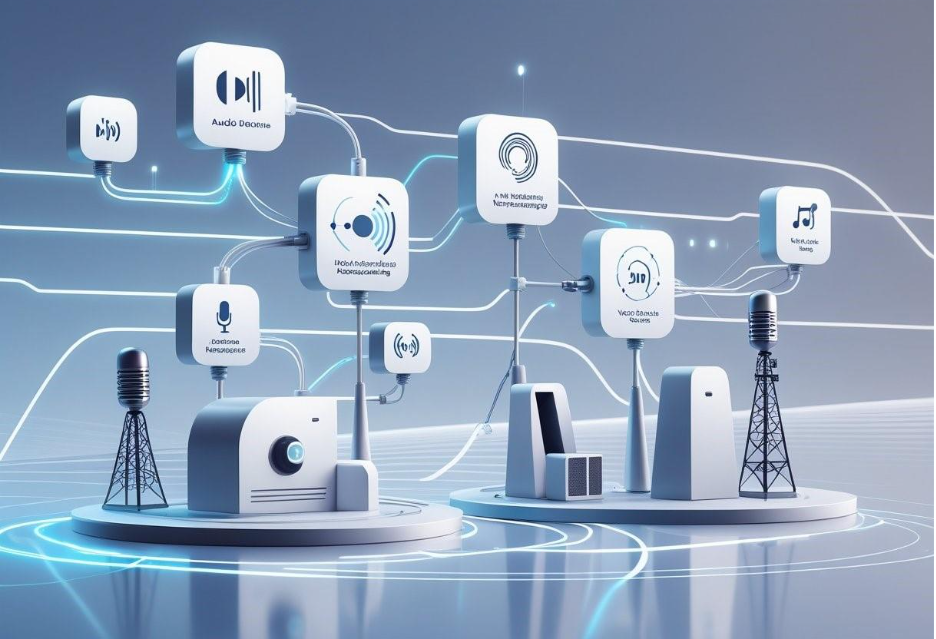
Low-latency voice AI systems depend on a seamless flow of data from capture to output. Each stage—from speech input to generated response—must operate efficiently to reduce delay and maintain natural back-and-forth communication in telecom environments.
Voice AI begins with audio data capture, which can occur through customer calls, IVR systems, or live support interactions. The system must work across varied network conditions and device qualities, so it uses noise suppression, echo cancellation, and volume normalization to improve input quality.
Preprocessing filters irrelevant sounds, separates speech from background noise, and aligns timestamps for accurate model timing. These steps ensure that acoustic models receive clean, consistent input.
A Voice Activity Detection (VAD) module plays a key role here. It detects when someone starts and stops speaking, which minimizes wasted processing time and allows faster transitions between listener and responder. In telecom scenarios, optimized data handling at this stage reduces latency and improves reliability.
Automatic Speech Recognition (ASR) converts spoken input into text. Telecom systems often use streaming ASR, which processes speech continuously instead of waiting for full sentences to end. This allows the AI to react almost instantly.
Modern ASR engines such as Whisper or telecom-specific models like TSLAM use lightweight, quantized architectures. Quantization helps models run efficiently on limited infrastructure without losing too much accuracy.
Error handling is vital in noisy telecom channels. Domain-specific tuning—such as recognizing industry terms, names, or call-routing phrases—improves recognition rates. The model may also maintain partial hypotheses to revise earlier words as context increases, keeping responses coherent in real time.
Once the speech-to-text step is complete, the Natural Language Processing (NLP) unit interprets what the user means. This often involves a Language Model (LLM) optimized for telecom tasks like customer support, billing, or troubleshooting.
Latency depends on how quickly the model can parse intent and generate a relevant response. To achieve this, systems use context caching, smaller prompt windows, or 4-bit quantized models that reduce computation load.
Integration between ASR and NLP happens through a shared buffer or message queue, which transfers recognized text in short segments. This continuous exchange prevents bottlenecks. By limiting waiting time between modules, the AI keeps conversation flow natural and responsive.
The final stage converts text responses into speech using Text-to-Speech (TTS) systems. Low-latency voice agents often use Edge-TTS or similar neural architectures that run inference locally or at network edges to minimize transmission time.
Real-time TTS models allow control over pitch, tone, and speed, letting telecom providers tailor voices for brand identity or accessibility. Systems can dynamically tune these elements to match context—slowing for clarity or quickening during queues.
To maintain conversational rhythm, the TTS engine starts playback as soon as possible, even while generating the rest of the audio. This streamed synthesis method shortens perceived delay and creates smoother dialogue between user and AI.

An effective voice AI infrastructure balances speed, scalability, and reliability. Telecom solutions require architecture that minimizes response delays, processes data close to the user, and manages real-time workloads across complex networks. These systems rely on a mix of edge devices, cloud environments, and optimized network paths to sustain low-latency performance.
Edge computing reduces latency by processing voice data near the user rather than routing it to distant servers. Telecom companies deploy mini data centers or local nodes close to cell towers and gateways so that voice packets travel shorter distances. This reduces round-trip time and improves responsiveness during live conversations.
By handling speech recognition, wake-word detection, and audio preprocessing at the edge, systems lessen dependency on remote servers. Edge nodes can also handle temporary network drops or delays, ensuring smooth audio flow. This design supports use cases like call routing, AI-driven IVR, and real-time translation without long pauses or lag.
A key benefit is cost efficiency. Processing frequent, lightweight tasks locally decreases data transfer to the cloud, saving both bandwidth and computing resources. Many telecom AI systems combine edge computing with selective cloud inference to balance real-time demands with model accuracy.
Cloud platforms host large language models and speech synthesis components that require high computing power. These resources support continual model updates, global scalability, and integration with third-party telecom frameworks. Cloud environments let providers manage complex AI pipelines—including ASR (Automatic Speech Recognition), NLP (Natural Language Processing), and TTS (Text-to-Speech)—more efficiently than fully local systems.
Advantages of cloud deployment include:
However, latency control depends on how well the cloud connects to edge gateways. Hybrid models linking edge and cloud infrastructures help reduce the gap between device input and AI response time. Providers use caching and streaming strategies to send only essential data to the cloud, maintaining near real-time communication.
High-quality, low-latency voice AI depends on an optimized telecom network. Network architecture must minimize jitter, packet loss, and routing inefficiencies that cause audible delays. Techniques include Quality of Service (QoS) tagging for voice traffic, adaptive bitrate control, and consistent bandwidth reservation for real-time streams.
Telecom engineers also use WebRTC and VoIP protocols tuned for conversational AI. These protocols support ultra-low latency communication paths, maintaining dialogue flow that feels natural to users.
Monitoring tools continuously measure latency and automatically reroute traffic through faster channels when congestion appears. In tightly integrated AI systems, optimization extends beyond routing. It also includes synchronization between the speech-to-text, response generation, and text-to-speech modules to reduce total pipeline delay to well under a second.

Telecommunications providers use real-time AI systems to process speech, detect anomalies, and support human-like interactions without delay. These applications rely on low-latency processing to keep conversations natural and secure within high-volume network environments.
AI-based call routing systems analyze caller intent as soon as speech begins. Using real-time automatic speech recognition (ASR) and natural language models, the system identifies keywords, tone, and emotion. It then directs each call to the most suitable department or virtual agent within milliseconds.
Key benefits include:
Telecom networks integrate streaming pipelines that process audio simultaneously with language inference. This avoids traditional queue-based delays and keeps the caller connected to the right support path.
AI models operate continuously across telecom channels to flag suspect activity. By tracking voice patterns, call frequency, and transactional data in real time, they detect behaviors linked to identity theft or account misuse. These models adapt as new fraud tactics appear, learning from large volumes of anonymized traffic data.
Examples of real-time checks include:
A low-latency pipeline ensures detection within seconds. This speed allows providers to freeze compromised accounts or reroute suspicious traffic before financial harm occurs.
Telecom companies employ conversational AI agents that respond instantly to voice queries. These systems combine streaming ASR, a language model for understanding requests, and text-to-speech (TTS) to speak back naturally. Sub-second processing makes the interaction feel similar to talking with a live agent.
Common tasks include billing inquiries, plan changes, and network troubleshooting. Real-time feedback loops allow agents to interrupt or clarify mid-conversation using barge-in technology. This design improves accuracy and reduces call duration.
Providers benefit by handling thousands of interactions at once, while customers experience consistent, quick responses without being transferred between departments.
Telecom providers face growing pressure to handle real-time voice AI interactions at scale while maintaining data compliance and processing speed. The push for ultra-low latency, stronger privacy controls, and integration with new edge and multimodal technologies defines how AI voice systems will evolve.
Large telecom networks must support thousands of simultaneous voice sessions without delay or dropped connections. Low-latency AI voice agents rely on distributed processing and load balancing across servers to keep response times under 300 milliseconds, matching natural human speech rhythm.
To ensure reliability, systems often use redundant data centers and dynamic routing. When one node fails, another instantly takes over to prevent service interruptions. Continuous monitoring detects latency spikes and reroutes traffic in real time.
Scalability also depends on efficient models. Telecom-specific large language models (LLMs) are often quantized to reduce computing demands. This allows deployments across more sites, including regional or on-premises locations, which improves performance and meets local regulatory needs.
| Scalability Focus | Example Technique | Benefit |
| Model optimization | Quantization, pruning | Faster inference |
| Network design | Edge routing | Reduced delay |
| Cloud-hybrid setup | Local caching | Reliability and continuity |
Voice AI systems process sensitive speech data, often containing personal or account-related details. Telecom operators must meet strict data sovereignty and GDPR-style regulations by keeping user data within national boundaries and controlling third-party access.
Edge computing helps mitigate privacy risks by handling initial processing locally rather than in remote data centers. This reduces exposure and allows faster response times. Encryption—both in transmission and at rest—remains essential to protect customer interactions.
Developers must also address the risk of model leakage, where AI models unintentionally store private information in their weights. Regular audits, access controls, and model retraining policies can maintain compliance and transparency with customers.
Several innovations aim to enhance telecom-grade AI voice agents. Multimodal AI combines voice, text, and application data, creating smarter responses tuned to user intent. Edge processing reduces latency by placing inference closer to the user, improving real-time adaptability.
Adaptive learning models analyze sentiment and context to adjust responses dynamically, giving more natural interactions. Telecoms also experiment with agentic AI systems that proactively engage customers by predicting needs before a query arises.
Future networks may integrate 5G and AI orchestration to manage millions of voice transactions seamlessly. Together, these trends position low-latency voice AI as a cornerstone of next-generation telecom customer support.
Low-latency voice AI in telecom relies on precise coordination between speech recognition, language models, and speech synthesis. It focuses on speed, stability, and secure infrastructure to deliver natural and efficient voice interactions.
What are the components of an effective AI voice pipeline in telecom?
An effective pipeline includes Automatic Speech Recognition (ASR) for real-time transcription, a Language Model (LLM) for context processing, and Text-to-Speech (TTS) for natural voice output.
It also includes routing, data handling, and latency management layers that synchronize communication between systems. Telecom-grade setups often optimize each step to reduce end-to-end delay.
How does low-latency impact user experience in real-time voice AI applications?
Low latency determines how human-like and responsive a system feels. When response times stay under 300 milliseconds, conversations flow naturally, reducing perceived pauses.
High latency can cause awkward gaps, making the interaction feel robotic or unresponsive.
What are the challenges in implementing AI-powered telecom systems?
Telecom operators face challenges such as network instability, scaling costs, and integration with legacy systems.
Ensuring consistent performance across large call volumes and maintaining low latency across global regions can be difficult.
In what ways can real-time speech AI enhance telecom services?
Real-time speech AI supports faster call routing, automated responses, and multilingual communication.
It allows call centers to manage higher volumes, improve first-call resolution, and provide consistent customer experiences.
What strategies are utilized to ensure the scalability of voice AI infrastructure?
Scalable architectures rely on cloud-based processing, distributed computation, and adaptive bandwidth management.
Edge computing helps reduce transmission delays, allowing local processing for faster response times. Load balancing further stabilizes performance during peak use.
How can telecom companies ensure data security when using real-time speech AI?
Security involves encrypting voice data, anonymizing sensitive information, and following telecom privacy regulations.
Regular audits, secure APIs, and compliance with frameworks like GDPR or CCPA help maintain data protection without adding significant latency.